
What is True Managed WiFi?
Understanding True Managed WiFi Services High-speed internet is no longer a luxury - it's a...


Managed WiFi is a property-wide wireless network that a third-party provider designs, installs, monitors, and maintains, so an entire building gets one secure, professionally run connection instead of every unit setting up its own internet. The property owns the network; the provider runs it.
In a multi-dwelling unit (MDU) like an apartment community, student-housing complex, or senior-living campus, that means residents get fast, reliable WiFi the moment they move in, and the on-site team never has to troubleshoot a router again. DojoNetworks delivers managed WiFi for MDUs nationwide.
"Managed WiFi" means WiFi delivered as a service. Rather than buying access points and asking staff (or residents) to run them, the property hands design, installation, monitoring, security, and support to a specialist provider. The provider owns the day-to-day operation, and the property owns the asset and the resident relationship.
It is sometimes called WiFi-as-a-Service, property-wide WiFi, or community WiFi. In an apartment context it is the alternative to two older models: bulk internet (one ISP pipe split across units) and resident-provided internet (every tenant signs up with their own provider). If you're interested in how managed WiFi compares to those, see our article about Managed WiFi vs. Bulk WiFi.
How Does Managed WiFi Work?
A managed WiFi network blankets the whole property with professionally placed access points, controllers, switches, and cabling, all fed by the building's bandwidth or a dedicated fiber line. The provider monitors performance and usage 24/7 and resolves issues remotely, so the on-site team is never the help desk.
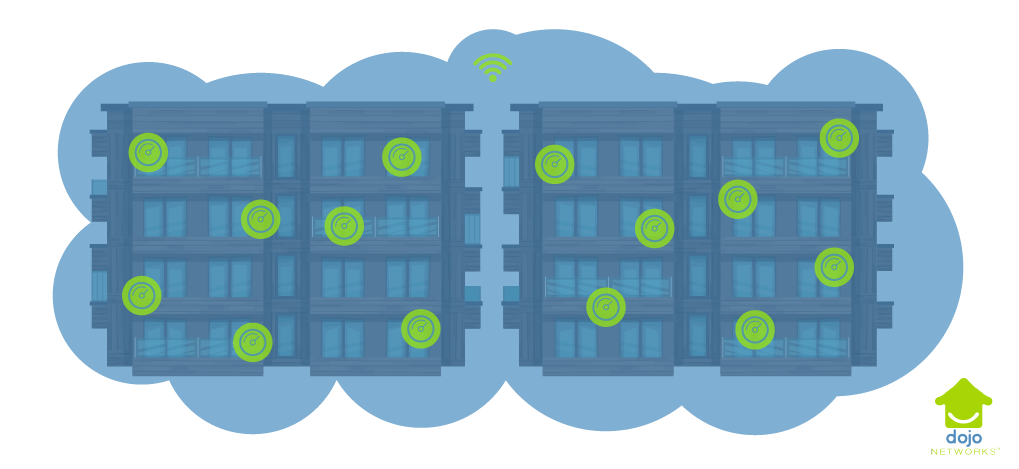
Dojo's network is "self-healing.” If one access point fails, the nearest access point takes over that unit's responsibilities, so the internet keeps flowing seamlessly rather than seeing competing services bounce off each other. Behind the scenes, the system continuously tunes the wireless spectrum to reduce WiFi interference from competing devices and neighboring units.
The technology also provides a virtual private network for each apartment, so every resident's devices sit on their own secure network. Residents control which devices connect, while neighbors and strangers are kept out or routed to a shared guest network.
Not all managed WiFi is built the same way:
Legacy managed WiFi: residents share access points mounted in hallways, spaced every few units. Coverage and speeds vary by how far a unit sits from the nearest access point.
Modern managed WiFi: every unit gets its own access point and its own secure private network, so performance does not depend on a neighbor's walls or usage. This is the model Dojo deploys.
A managed WiFi service typically includes the bandwidth or dedicated fiber line, network controllers, switches and cabling, around-the-clock monitoring, and resident support. Everything from the network design to ongoing troubleshooting is the provider's responsibility, not the property staff's. For what a typical project costs, see Managed WiFi Pricing for MDUs.
Building Access & Keyless Entry Systems: Keyless entry systems can be applied to the outside of a premise, but also rooms within a unit. This added security benefit can also be included in rent. It will save the tenant money for a key and will eliminate the chance of them losing their key.
Occupancy Sensors: Motion and smart occupancy sensors can be great for saving on energy costs. Allowing temperature controls to float a few degrees based on ambient temperature or turning off lighting when units are unoccupied can lead to cost savings.
Temperature Monitoring & Control Systems: Property owners can set temperature limits for units and still allow residents to set their own temperatures. Apps and controls can be added to maintain any tenants desired temperature range.
Connected Vending Machines & Appliances: Vending machines are a hidden feature that can generate plenty of profit. The service provider can control vending machines, and keys can be made to load funds on, ensuring unwanted visitors do not gain access.
This can be applied for washing and drying units as well. Being able to advertise these added amenities can be a significant pricing advantage.
Smart Metering for Electric & Water: Smart metering can record electric and water usage electronically. Where traditional meters will measure how much is being used, smart meters determine when and how much is being used. By determining when the demand of each service is at its highest, these companies can work around tenants needs to adjust prices based on day and season. If you want to bill residents for usage you can or you can only bill residents that are High users that go beyond the standard usage.
Each feature can generate added revenue or can be offered as an added benefit to justify higher rent. Tenants can select add-ons that can be included in their lease.
If residents want faster speeds that the base plan that you are including, they can upgrade to faster packages. We handle all billing and revenue share 50% of the upgrade fees back to the property.
Managed WiFi fits any property where one team is responsible for connectivity across many units. Some common property types we service include:
Managed WiFi pays off in two directions:
Residents get a better, instant-on connection
Owners turn internet into an amenity, and often a new revenue stream, without adding staff.
For the full breakdown of owner and resident benefits, see The Benefits of Managed WiFi. To see the financial impact on your property, try our Rental Profit / NOI Calculator.
Having managed WiFi networks can benefit your tenants and business by increasing speed, adding security, and putting less of the responsibility on the tenant's plate. In turn, this helps create a better relationship between the client and also gives the property owner a chance to increase rent and add other potential revenue options. However, it also can lead to customer retention, which is the most significant benefit.
With little work on your end, you can provide your tenants with a feature that your customers want, and need in their internet service.
Don't get left behind in the fast-paced world. If you are a property owner of any Multi-Dwelling Unit, managed WiFi has to be on your radar. DojoNetworks can install & support a high-speed WiFi network in your property. Contact us today with any questions, comments, or concerns to see if you are ready to take the next step and move to managed WiFi.

We’re Here to Help Through Top of the Line Technology And Professional Support.